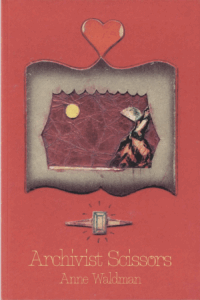
A Review of Anne Waldman’s Archivist Scissors
Archivist Scissors, by Anne Waldman. Staircase Books, 2025. 59 pages. $20.00
by Michael McGillicuddy
The Poetic Demand & The Gift of Poetry: On Anne Waldman’s Archivist Scissors
Archivist Scissors: a retrospective on the one hand, a creating on the other. Cutting up the archive and making out of it something new, which is nonetheless something old, related as it is to the archive. Older than old? Certainly—Waldman’s poetry gives us to the origin of language, wherein the materiality, the sound of the word and the meaning of the word are not yet scissioned. So the poem “Buoyant” says, “I’ll sing to the elements / in my archivist scissors.” The song addressed to the elements and of the elements, unearthed in the workings (unworkings?) of the archivist scissors. Cutting up in order to unify, disarticulating in order to articulate? A Burroughsian, a Kristevan demand. What are we to make of Waldman’s poetic gift, to what end is Waldman giving it to us—how should we be to best receive it?
The self-evident sensuous beauty of Waldman’s poetic word can’t be given by criticism, for, in taking it as my object, I have separated the meaning of the word and the materiality of the word. As soon as I describe her words with different words—different marks, sounds—I’ve subordinated material to meaning. Criticism is something of a virus, then, burrowing itself into the body of work. And suddenly Burroughs is back on the scene, brought to the fore with the evocation of the word virus—of whom Waldman described in Fast Speaking Woman as empowering her “with his uncompromising sense of the wicked power and magic of words.” Says in “Existential,” contra Burroughs,
Language is not virus if we take back
Its power, our mundane but a tool
toward sound, and beauteous telepathy
“toward sound,” and so reuniting the meaning, the use of the word (“a tool”) with its materiality. Nonetheless the “if,” the agreement with Burroughs that we are, in our everyday, subject to the “dead labor” of the word virus, doomed to reproducing “meaningful” relations for the virus, of the virus—and so reclaiming relations for ourselves, reclaiming the space of mediation, is the poetic task. Taking back the word’s power, disclosing the promise of “beauteous telepathy,” founding a radical community. Archivist Scissors is a poetic fulfillment of the task, overflowing as it is with homages, dedications, quotations, evocations to the dozens of people coming into presence with, through, as Waldman.
“And all of us ‘in relation’ to all the fabulous others,” Waldman says in the expansive “Fugue State,” a poem in which the power of language is certainly reclaimed, but for whom? Not only for Waldman, as if she, as seer-poet, stood above and beyond us, the reader (listener?)—and we know this because the poem is a fugue state, a poem in which the validity of the responsible subject isn’t merely contested but thrown aside, the poem rapidly moving from association to association, carving out relations otherwise inaccessible to the grammatically coherent “I.” “[C]ome to this Kristeva moment,” “Ponder” says, and Archivist Scissors is a collage of “Kristeva moments,” for the poems are all concerned with unearthing what Kristeva calls “the semiotic,” the generative, disruptive, rhythmic chaos out of which our everyday symbolic codes are always drawn—which is at once the disclosure of other possible manners of being oriented toward the world and toward others. Others “fabulous” not only in our good fortune of being in relation to them, but in their possibility, their as yet unrealized potential, their unreality—elsewhere described by Waldman as “all karmas we are party to.”
Language gives itself to us and, being in this relation, we must in turn give language our responsibility toward it—which is not to be found in a particular discourse touting itself as universal, but in language’s holding open (for us!) the possibility of discourse at all—which is not nothing, not an empty potentiality I attempt to indicate by pointing confusedly to my apparently thinking head, but the materiality of the word, the word meaning its materiality.
Waldman takes up a double negation in “What Is an Individual if not This Genius,” a prose poem negating prose’s tendency toward meaning, prose being the negation of the materiality of the words constituting it. Like Rimbaud, like Burroughs in his Nova Trilogy, in which Rimbaud is folded. Burroughs’ forceful, disarranged, sensuous style characteristic of his cut-ups is echoed in Waldman’s poem, but the poem—contra Burroughs, who wanted at all costs to “rub out the word,” to find a means of communication “healthier” than language—preserves language and, in that preserving, brings language back to its materiality and re-apprehends “its power,” its tendency “toward sound,” its promise of “beauteous telepathy.”
Meredith thinking with the things she loves. Languaging her hold on them. Sing
with them a Turtle’s dream. Dakini language whispered in twilight. Oracular now
time.
Ways of eyes and syllables may blaze together in genetic zone. Ritual space as
emptiness dials down. Vulnerable and climbing. Spiraling and standing still. And
take all with you. A dialogue in the antechamber. Poiesis in the culture wars.
Oneiric dreams of synergy fielding 200 billion galaxies Spaces are already sacred,
and scary, and we’ll stand by our words.
Through the poetic word’s disruption of our everyday symbolic codes, which have always already assigned to “me” an everyday sense of which my being must, and apparently always already does, reflect—the most obvious of which is: I am I, I possess the words I say and I can be held against, exchanged with the words I say—and through deploying implicit quotation and the cut-up method to speak as others (“I is another,” so Rimbaud, “I am a dissipative structure—a flowing apparent wholeness, highly organized but always in process,” so Waldman), Waldman’s work discloses a radically communal, communally radical poetic space. The work calls attention to the fact that the language I speak is never simply my own, that language always implies a relation and so is charged with instability—and is therefore not something “I” “simply” “possess.” So what does Waldman’s poetry give us in its uncovering of a space not yet subjected to the reign of the everyday? The insurrectionary depth of poetic speech.
Arriving at the limit of everyday sense—a sense indicated through the adherence to grammatical standards, the utterance sensible insofar as it maintains itself within these standards and valuable insofar as it is simultaneously a justification of and expression of these standards, part of a system and so exchangeable against any other utterance, term in that system—which is to say, transgressing everyday sense through an operation that makes it inoperative, intimating not nonsense but the possibilities of senses other than, and so beyond, the limits of the everyday. Our everyday? Banal capitalist nightmare of complicity glazed over in the name of a “social contract” from which the sensible possibilities of “human being” are drawn.
I’ll sing to the elements
with my archivist scissors
dance on the mall in a cut-out
dakini mask
what I own
mark the elements
as waves of emotion
ring breath to
the country that didn’t quite go fascist
“[D]idn’t quite go fascist,” that is, that still has hope, possibility of shaking itself awake, of finding a rhythm unearthed in poetry, enjoyed in poetry. A good fortune which knows itself to be fortunate through its responsibility toward poetry’s space. Demand of responsibility. Part of Waldman’s “Core Text” reads: “We are here to benefit others and disappear.” The opening of the book’s second poem, “Burkina Faso”:
Dearest Mayra—
O big full moon. Yr grandfather—is there a photo of you with him? Friend had
sent shaman words from Burkina “prophecy” of Gaza, the layers, pooling of
blood, many generations, how hard even stand on that surface—how deep the
murders—deliberate violence—& remember Buddhist view of all karmas we are
party to … Manifold grey areas … our USA complicity, our taxes alone turn
weapons. Watched Steve McQueen’s “Occupied City,” terrifying Amsterdam,
looking so sterile. And the addresses & names, a horrible tally. You speak of vow
what’s not been defended … that’s what I am asking of people their vow (their
voice, what standing tall far different from opinion) what needs be stood up for. I
need to communicate with you, poetry thru the day waves & night waves. All the
peoples of truth and suffering.
Why the single reference to Gaza in a part of the work which shows itself outside of poetry, that is, in the form of a letter in which the meaning of language is once again privileged over its materiality—a prose which, though trembling, seeks to understand and to teach? If the first poem of the book serves to orient us, it follows the stakes of the book might be sketched out in the second. Certainly. More profoundly, it is perhaps because to enjoy in sound and meaning implies the accomplishment of a task that could be called poetry, the accomplishment of taking the language I speak and bringing it back toward that space in which it has not been subject to laceration. From this perspective, to speak of Gaza poetically would be to imply the accomplishment of reuniting the material reality of Palestinian forms of life with what might be called the “meaning of Palestine,” a relation in which Zionist oppressors have always already intervened, have appropriated as their own and for their own ends. That poetic enjoyment, then, would be for us (“our USA complicity”), but certainly not for the Palestinians. Gaza, the impossibility of its accomplishment in this poetry: inscribed within this painful separation beyond the language of pain is the task Waldman gives us. “[T]hat’s what I am asking of people their vow…” A demand reaching beyond, nevertheless nourished by, poetry.
Michael McGillicuddy is a writer living in Massachusetts. His work can be found in Arts & Letters, Harvard Review, Soundings East, and elsewhere.