A Review of Michelle Lewis’s Spare
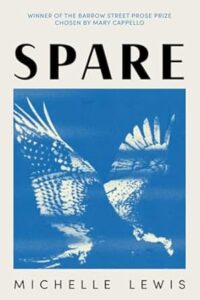
Spare, by Michelle Lewis. Barrow Street Press, 2025. 192 pages. $20.00
by Samantha Colicchio
Zeno’s Paradox describes the way reason diverges from reality. Mathematics teaches us that to walk one mile home, a person must continually “halve the half”: first, they must walk half a mile, and then a quarter of a mile further, and an eighth of a mile further, and then one-sixteenth of a mile further. Continue to add these halved fractions, and the person can never actually reach the mile mark—they are forever approaching it. How, then, can we reconcile them finally arriving home? Is reaching their doorstep an abomination of mathematics, or a miracle?
Michelle Lewis’s breathtaking Spare, a lyric memoir set in Maine, explores fate and fortune through the lens of genetics, class, location, and privilege. Lewis is from one of the poorest towns in Maine, in a region teeming with addiction and “white trash” and a history of eugenics practices, but she lives in an A-frame with her parents and sister and a beautiful nude woman carved into the wood at the top of the stairwell: their own family symbol of fortune. She works with her friend raking blueberries so that she can buy clothes to “pass as fortunate.” Her parents own a restaurant that employs the poorer folks in their town. In a place of violence and drug abuse, she has been “spared”—but just barely. She lives on the cusp: “half of one thing and half of something else.”
What does it mean to reach that mile marker, to transcend the infinite halves and become something else, something impossible? How can we escape what we have inherited? Do we need to? Lewis quotes Robert Browning’s philosophical poem Rabbi Ben Ezra, a meditation on the rabbi’s ideas on fortune. While the book has no overt religious references, the Browning poem points to ideas of divine orchestration, of good coming out of misfortune:
What do we have here, a stillborn. My grandmother tells the story
over and over. It is the same each time: the doctor, who loved
baseball, left to catch the end of the game. When he came back, he
said, c’mon little baby c’mon. Everyone in the waiting room could
hear. By then, the brain was starved, but there was still the body.
He slapped and slapped.
At that point in the story, you might make a plea that air does not
strike the lungs. You might urge the veins not to gulch themselves
with blood. You might say, don’t take that palm of air.
And then she cried.
Lewis meditates upon the idea of “the separation”—the moment when fortunes change. Where does fortune exist? In the genes? In the brain? In the family? In the town? Is fortune a paradox, like Zeno’s? J survived her birth, and that is a miracle. Her brain was impacted by the lack of oxygen, and now J eats ravenously, lunges at others in the library, breaks the good china. Lewis describes her as “like us, with the boundaries lowered.” She tells the reader of J’s love for full-bodied skirts, and describes an image of her spinning in one, the skirt almost parallel to the floor. There is a fierce beauty in J.
Still, there are those who believe they know better than fate. Lewis writes of William Shockley, co-inventor of the transistor and a prominent figure in the eugenics movement, who believed that “cleansing” the population of “the feebleminded” would make for a more intelligent and desirable population. He donated his sperm to the Genius Sperm Bank “to help clean so-called polluted bloodlines.” The sperm bank was a failure and Shockley was eventually ridiculed.
Humming beneath the brutal, often grotesque landscape of the book is a quiet, profound philosophical inquiry. Through sections separated by definitions of spare, Lewis asks: what makes a life worthwhile? What is the truth? What do we inherit? Is fortune random, “the tornado that rips through, decimating one house while the next one is untouched,” or is it in the blood? If a person is “half of one thing and half of something else,” and if each child born means continually “halving the half,” how can we define a life as “fortunate” or “unfortunate”? How can we define an abomination, and how can we recognize a miracle? Lewis quotes Sherwood Anderson in the epigraph, “Hundreds and hundreds were the truths and they were all beautiful.”
Samantha Colicchio is a creative literary fiction and nonfiction writer who focuses on themes of beauty, performance, nature, mental health, and the body. Her work has been published in the Huffington Post, Faultline, The Journal, and HerStry, and is forthcoming in Off Assignment and The Rambling.